
About

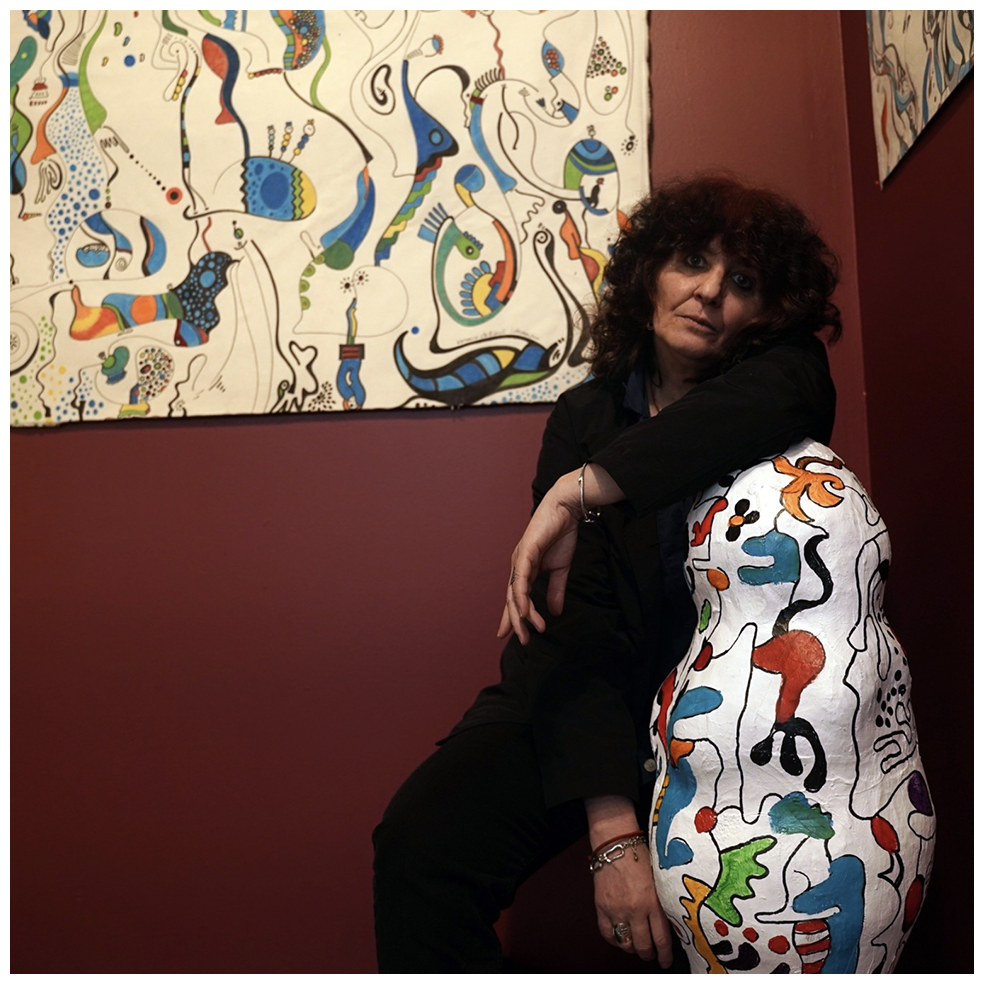
Woman with curly dark hair posing next to abstract artwork on a maroon wall. The artwork features colorful, whimsical shapes and figures.

Artist Bio

Nathalie Gribinski is a French-American abstract artist born in Algiers, raised in Paris, and now based in Chicago. Originally trained in law, she transitioned to the visual arts after moving to the United States, studying fine arts and
graphic design before establishing her studio practice.

Her work has been exhibited internationally and recognized through multiple illustration and poster awards, with pieces included in private and corporate collections. Over the past two decades, she has developed a distinctive creative career that spans painting, illustration, and design.

Gribinski continues to live and work in Chicago, maintaining an active studio practice and expanding her presence in national and international art spaces.


Artist Statement

“I paint to surprise myself.”

That may seem like a simple statement, but it lies at the heart of everything I do as an artist. I am not interested in arriving at a final destination or repeating what I already know. What excites me is discovery. Each painting is an opportunity to venture into unfamiliar territory and uncover something I did not know before I began.

Communication is equally central to my work. I seek it the way a fish needs water. Throughout my life, I have been fascinated by the invisible threads that connect us: to one another, to nature, to memory, to emotion, and to ourselves. Painting has become my most natural way of exploring those connections. A painting, for me, is not an object. It is a conversation.

Some conversations are playful. Others are emotional, mysterious, exuberant, or contemplative. As in life, no two conversations are ever the same. This may be why my work has evolved through many different visual languages over the years. While the appearance of the paintings changes, the underlying impulse remains remarkably consistent: a desire to create connections between things that seem separate.

One of the most important of these languages is the Tourlicoulis. Derived from a word invented by my brother, the Tourlicoulis gradually evolved into a visual vocabulary with its own symbols, rhythms, recurring forms, and internal logic. What began as playful drawings became an ecosystem inhabited by characters, gestures, signs, and conversations. Over time, this language expanded into multiple series while retaining the same spirit of curiosity, invention, and connection.

Communication lies at the center of this world. Hands, which appear frequently in my work, symbolize generosity, exchange, and human warmth. Lines suggest movement, journeys, and transformation. Dots become rhythm, presence, and time. These elements reappear across different bodies of work, creating relationships between paintings produced years apart.

Color has always been one of the driving forces in my work. I am drawn to vibrant contrasts, unexpected combinations, and the energy that emerges when colors interact with one another. Red appears frequently in my paintings, perhaps because it embodies something essential to me: vitality, passion, and a sense of completion. Color is often the first point of contact with a painting, but for me it is never decorative. It creates rhythm, tension, harmony, and movement, allowing forms to come alive and enter into conversation.

Music is one of the invisible companions in my studio. I often paint while listening to French songs that accompanied my childhood or to classical works that have remained with me for years. Their familiarity allows me to stop thinking and simply feel. They reconnect me to memories, emotions, and dreams, creating an atmosphere from which paintings can emerge. People often describe my work as musical, and I understand why. The flow of a line, the rhythm of repeating forms, and the movement of color across a surface often follow a logic that feels closer to emotion than to explanation.

Although my work is often playful, it is rooted in depth. Years ago, Christine Ruiz Picasso remarked that she saw both suffering and joy in my paintings. Her observation stayed with me because it captured something essential. I have never experienced joy and sorrow, humor and depth, hope and vulnerability as opposites. They coexist, enrich one another, and shape the emotional landscape from which my paintings emerge.

Humor occupies an important place in my art. The world can be heavy, and I often respond to that heaviness with playfulness. Many of my forms, creatures, and visual encounters contain a sense of joy, surprise, or gentle absurdity. Humor, for me, is not an escape from reality but a way of embracing it with openness and generosity.

I rarely begin a painting with a fixed message. Instead, I follow intuition, curiosity, and discovery. The moments I value most are those when a painting reveals something I did not anticipate. Those moments still feel magical to me.

Although my work spans multiple series and visual approaches, I do not see these differences as contradictions. They are different dialects of the same language. Whether I am working with imagined beings, organic forms, vibrant abstractions, or the evolving world of the Tourlicoulis, I return again and again to the same questions: How do we connect? How do we communicate? How do we create harmony while remaining distinct?

I do not paint to illustrate answers to these questions. I paint because the questions themselves continue to fascinate me.

Every new painting begins with uncertainty, and I welcome that uncertainty. I never fear the blank canvas. On the contrary, it represents possibility. It is an invitation to discover, to wander, to listen, and to be surprised.