Acrylics and oil markers on paper
12 × 9 × 0.1 in
2025
In The Botanist’s Dream, plants are not studied—they are imagined.
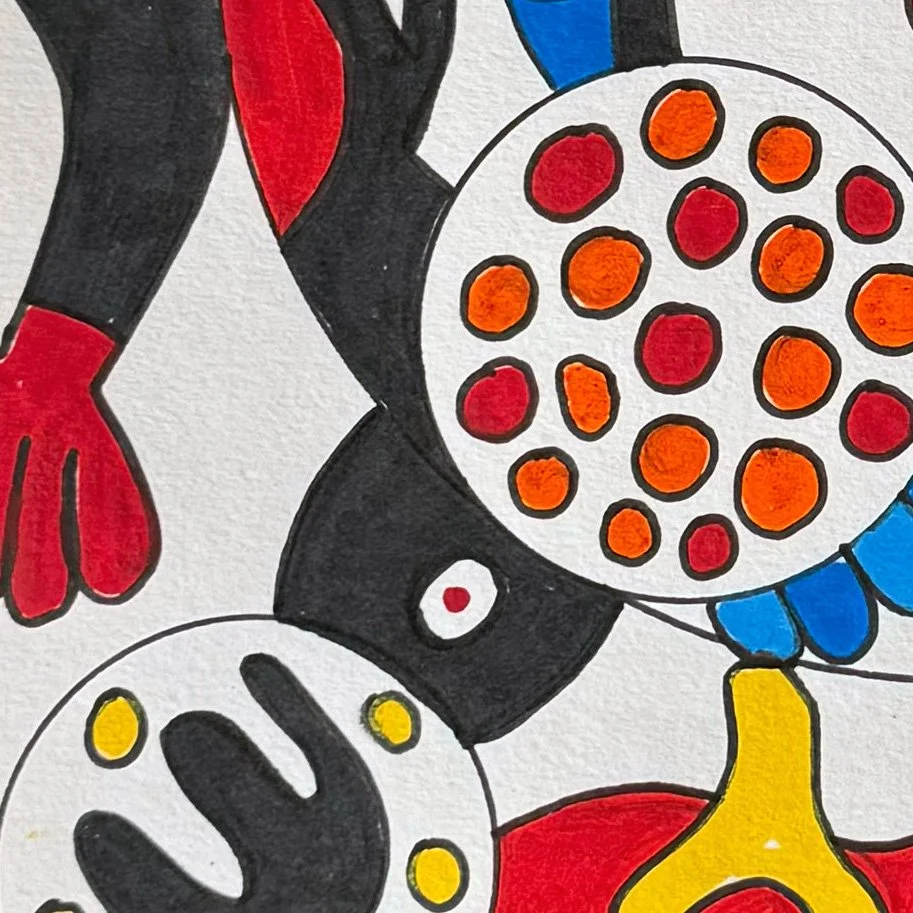
A flower occupies the center of the composition, yet it is unlike any flower found in nature. Its petals are made of circles, dots, and geometric rhythms. Around it gather curious beings, half-human and half-symbol, as if they have emerged from the flower itself or come to consult it.
The title suggests a botanist who has spent so much time observing the natural world that observation gradually turns into dreaming. In that dream, the boundaries between species dissolve. Flowers acquire personalities. Birds become ideas. Faces grow out of stems. Roots transform into pathways of thought.
Color plays a vital role in this transformation. The strong reds and yellows evoke pollen, sunlight, and vitality. Blue introduces a sense of cool reflection, while orange brings warmth and movement. Black anchors the composition, giving structure to a world that might otherwise drift entirely into fantasy.
Several eyes appear throughout the painting, quietly observing. They remind us that this is not merely a garden but an act of looking. The botanist's true subject is not the flower itself, but the mystery of growth and the endless variety of forms that life invents.
The central flower becomes a kind of sun around which the other elements orbit. It is both specimen and inspiration. Around it, figures bend, stretch, and intertwine, participating in an ecosystem where imagination is as important as biology.
The Botanist’s Dream celebrates the moment when knowledge gives way to wonder. It suggests that the deeper we look at nature, the more mysterious it becomes, until observation turns into poetry and every flower contains the possibility of an entire world.
Acrylics and oil markers on paper
12 × 9 × 0.1 in
2025
In The Botanist’s Dream, plants are not studied—they are imagined.
A flower occupies the center of the composition, yet it is unlike any flower found in nature. Its petals are made of circles, dots, and geometric rhythms. Around it gather curious beings, half-human and half-symbol, as if they have emerged from the flower itself or come to consult it.
The title suggests a botanist who has spent so much time observing the natural world that observation gradually turns into dreaming. In that dream, the boundaries between species dissolve. Flowers acquire personalities. Birds become ideas. Faces grow out of stems. Roots transform into pathways of thought.
Color plays a vital role in this transformation. The strong reds and yellows evoke pollen, sunlight, and vitality. Blue introduces a sense of cool reflection, while orange brings warmth and movement. Black anchors the composition, giving structure to a world that might otherwise drift entirely into fantasy.
Several eyes appear throughout the painting, quietly observing. They remind us that this is not merely a garden but an act of looking. The botanist's true subject is not the flower itself, but the mystery of growth and the endless variety of forms that life invents.
The central flower becomes a kind of sun around which the other elements orbit. It is both specimen and inspiration. Around it, figures bend, stretch, and intertwine, participating in an ecosystem where imagination is as important as biology.
The Botanist’s Dream celebrates the moment when knowledge gives way to wonder. It suggests that the deeper we look at nature, the more mysterious it becomes, until observation turns into poetry and every flower contains the possibility of an entire world.