Acrylics and oil markers on paper
12 × 9 × 0.1 in
2025
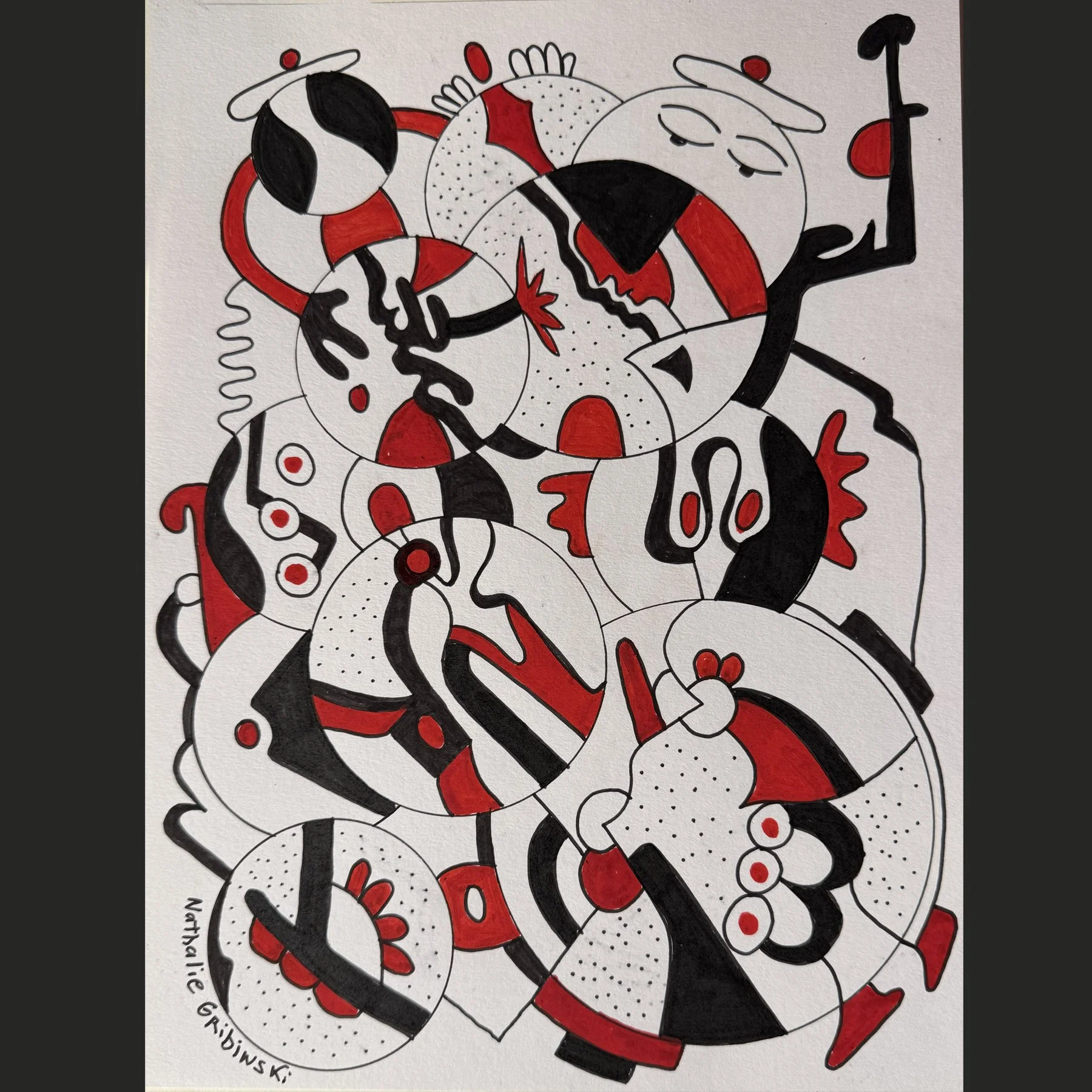
Unlike many Tourliboulis where colors multiply and compete for attention, Rehearsal of Shadows limits itself almost entirely to red, black, and white. This restriction changes everything.
The absence of blue, green, yellow, and orange creates a quieter, more concentrated atmosphere. The painting feels less like a celebration and more like a conversation taking place behind closed doors. The forms seem to be rehearsing something before it is revealed.
Red becomes the emotional pulse of the composition. It appears in fragments, crescents, dots, and gestures, moving through the painting like a heartbeat. The red shapes create moments of warmth, desire, urgency, and life. They are the sparks that prevent the work from becoming silent.
Black acts differently. Here it is not darkness but structure. It defines the boundaries of the forms, creates rhythm, and gives weight to the composition. The black shapes weave through the circles like shadows moving across a stage, connecting one figure to another.
White provides breathing space. It allows the forms to emerge and retreat at the same time. The white areas feel unfinished in the best sense of the word—as if the figures are still becoming themselves.
The circular forms dominate the painting, creating the impression of characters gathering inside a series of overlapping worlds. Faces appear, disappear, and reappear. A bird-like profile emerges from one circle while another contains what looks like a flower, a mask, or a memory. Nothing is fixed.
The title Rehearsal of Shadows suggests a moment before performance. These figures are not yet acting; they are preparing. The colors reflect this idea perfectly. Red supplies emotion, black supplies form, and white supplies possibility. Together they create a world suspended between appearance and disappearance, where identities are tried on, exchanged, and transformed before stepping into the light.
Acrylics and oil markers on paper
12 × 9 × 0.1 in
2025
Unlike many Tourliboulis where colors multiply and compete for attention, Rehearsal of Shadows limits itself almost entirely to red, black, and white. This restriction changes everything.
The absence of blue, green, yellow, and orange creates a quieter, more concentrated atmosphere. The painting feels less like a celebration and more like a conversation taking place behind closed doors. The forms seem to be rehearsing something before it is revealed.
Red becomes the emotional pulse of the composition. It appears in fragments, crescents, dots, and gestures, moving through the painting like a heartbeat. The red shapes create moments of warmth, desire, urgency, and life. They are the sparks that prevent the work from becoming silent.
Black acts differently. Here it is not darkness but structure. It defines the boundaries of the forms, creates rhythm, and gives weight to the composition. The black shapes weave through the circles like shadows moving across a stage, connecting one figure to another.
White provides breathing space. It allows the forms to emerge and retreat at the same time. The white areas feel unfinished in the best sense of the word—as if the figures are still becoming themselves.
The circular forms dominate the painting, creating the impression of characters gathering inside a series of overlapping worlds. Faces appear, disappear, and reappear. A bird-like profile emerges from one circle while another contains what looks like a flower, a mask, or a memory. Nothing is fixed.
The title Rehearsal of Shadows suggests a moment before performance. These figures are not yet acting; they are preparing. The colors reflect this idea perfectly. Red supplies emotion, black supplies form, and white supplies possibility. Together they create a world suspended between appearance and disappearance, where identities are tried on, exchanged, and transformed before stepping into the light.